What Affects Pool Resurfacing Costs in Sydney?
If you’ve searched for pool resurfacing costs online, you’ve probably noticed that prices vary enormously between quotes. That’s not because companies are pulling numbers from thin air. It’s because the cost of resurfacing a pool depends on a combination of factors that genuinely differ from one property to the next.
These are the main variables that affect your final price:
- Pool size: a small plunge pool costs significantly less to resurface than a full-length lap pool or an irregular freeform pool. Labour and material costs scale with surface area.
- Surface material chosen: epoxy coatings are the most affordable option; marblesheen and pebblecrete sit in the middle range; complete interior renovations with new tiling are at the higher end. See our pebblecrete pool resurfacing Sydney guide.
- Condition of the existing surface: a pool that just needs a new coat over a sound surface costs less than one that requires crack repair, delamination removal, or structural prep work before any new finish can be applied.
- Repair work required first: cracks in the shell, osmotic blistering on fibreglass, or failed waterproofing all need to be addressed before resurfacing. This adds to the overall cost but is essential — resurfacing over damaged substrate fails early.
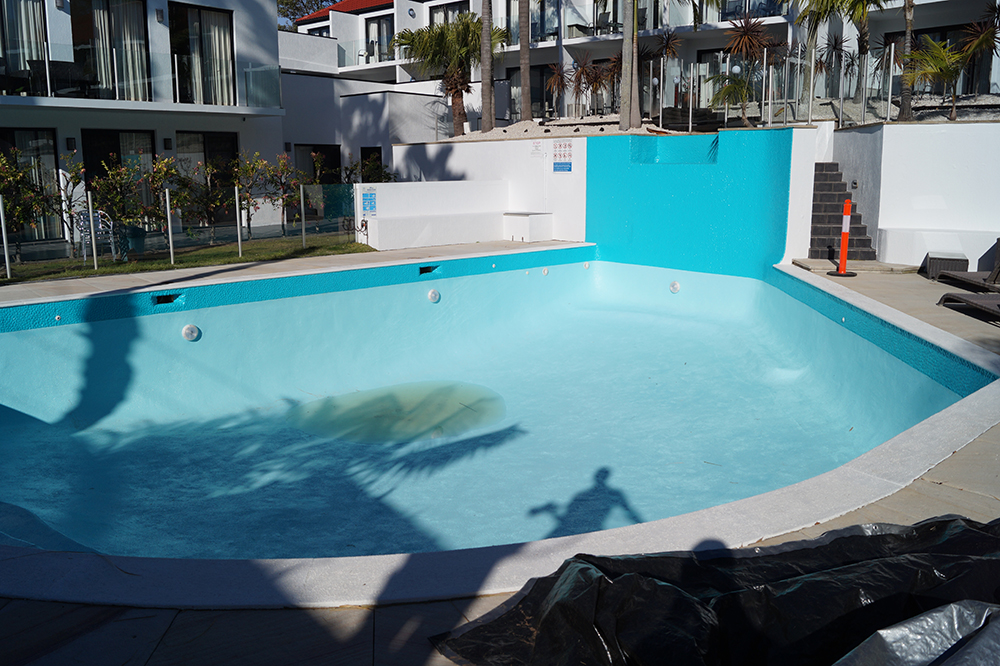
- Tiling, coping, and paving: if you’re replacing waterline tiles, coping stones, or surrounding paving at the same time, these are separate line items in the quote. Many pool owners combine these into a single project while the pool is already empty.
Pool Resurfacing Cost by Surface Type
To give you a realistic starting point, here’s how costs typically compare across the main resurfacing options for Sydney pools. These are indicative ranges — your exact cost depends on pool size, condition, and location. Contact us for a free quote specific to your pool.
| Surface Type | Indicative Cost Range | Typical Lifespan | Best For |
|---|---|---|---|
| Epoxy Pool Paint / Coating e.g. Luxapool, Megashield |
Most affordable | 5–8 years | Pools needing a cost-effective refresh; fibreglass and concrete pools |
| Marblesheen | Mid range | 10–15 years | Concrete pools; popular finish across Sydney suburbs |
| Pebblecrete | Mid to upper range | 15–20 years | High-use pools; durable textured finish; conceals surface imperfections |
| Fibreglass Resurfacing | Varies — get a quote | 10–15 years | Fibreglass pools with crazing, blistering, or faded gel coat |
Note: exact pricing depends on pool size, condition, and access. The only accurate price is one based on an on-site inspection of your specific pool.
Additional Costs to Factor Into Your Budget
The resurfacing itself is the core cost, but most pool restoration projects involve at least some of the following additional items. These are worth budgeting for upfront rather than treating as surprises mid-project:
- Waterline tile replacement: tiles at the waterline are often the first to show age, with grout failure, cracking, and calcium build-up. Replacing them while the pool is already empty adds relatively little to the project cost and dramatically improves the finished result.
- Coping stone replacement: the coping around the pool edge takes significant wear and UV exposure. If it’s cracked or heavily stained, replacing it during a resurfacing project makes practical and aesthetic sense.
- Surrounding paving: if pool surrounds are lifting, cracking, or stained, addressing them alongside the pool itself gives a cohesive result and avoids having to drain the pool again later.
- Structural repairs: any cracks in the pool shell, failed render, or delamination of existing surface material needs to be repaired before a new finish is applied. These repairs are non-negotiable — skipping them shortens the lifespan of the new surface significantly.
Is Pool Resurfacing Worth It vs Pool Replacement?
For most Sydney homeowners, pool resurfacing is far more cost-effective than pool replacement. A full pool demolition and new construction typically costs many times more than a complete resurfacing and renovation of the existing pool — and takes significantly longer to complete.
Pool resurfacing makes sense when:
- The pool shell (the concrete or fibreglass structure) is structurally sound
- The existing plumbing and filtration system is in working order
- The pool is simply showing surface wear, fading, or cosmetic damage
Pool replacement may be necessary when the shell itself is structurally compromised — large settlement cracks, significant hydrostatic movement, or a fibreglass pool that has shifted on its base. In most cases, our team can assess this during an inspection and give you an honest recommendation.
How to Get an Accurate Pool Resurfacing Quote in Sydney
Online cost guides can give you a starting point, but they cannot tell you what your pool actually needs. The only way to get an accurate price is an on-site inspection by an experienced pool restoration specialist.
During a site visit, a qualified pool restorer will assess the condition of the existing surface, identify any repairs required before resurfacing, confirm which materials are appropriate for your pool type, and measure the exact surface area to be coated. This is what a real quote is based on — not a square-metre rate applied to a number you’ve typed into an online form.
Pool Restorations has been carrying out on-site assessments and providing free quotes across Sydney for over 40 years. We work on all pool types — concrete, fibreglass, pebblecrete, marblesheen, vinyl, and modular — and service all Sydney suburbs, the Central Coast, Newcastle, Hunter Valley, and surrounding outer regions.
Want an accurate price for your Sydney pool? We’ll come to you, inspect the pool, and give you a free quote with no obligation. 40+ years experience, all pool types, all Sydney areas.
Frequently Asked Questions — Pool Resurfacing Cost Sydney
How much does pool resurfacing cost in Sydney?
Pool resurfacing costs in Sydney vary depending on pool size, surface type, and the condition of the existing finish. Epoxy coatings are the most affordable option; marblesheen and pebblecrete cost more but last longer. The only accurate price is one based on an on-site inspection — contact us for a free quote specific to your pool.
What is the cheapest way to resurface a pool in Sydney?
Epoxy pool coatings such as Luxapool and Megashield are the most affordable resurfacing option for concrete and fibreglass pools. They typically last 5 to 8 years with proper maintenance. If budget is the primary consideration, an epoxy coating is a practical choice — though marblesheen or pebblecrete will last significantly longer if you’re planning to stay in the property.
How long does pool resurfacing last in Sydney?
Lifespan varies by material. Epoxy coatings typically last 5 to 8 years. Marblesheen finishes last 10 to 15 years. Pebblecrete finishes can last 15 to 20 years or more with proper water chemistry maintenance. All finishes last longer when the pool water is correctly balanced and the surface is not subjected to aggressive chemical treatments.
Do I need to factor in tiling costs as well as resurfacing?
Not always, but it’s worth considering. If your waterline tiles are cracked, stained, or the grout has failed, replacing them while the pool is already empty is practical and cost-effective. We handle all tiling and coping work as part of a complete pool restoration — you won’t need to call a separate tradie for that.
Is it cheaper to resurface or replace a pool in Sydney?
In almost all cases, resurfacing is significantly cheaper than pool replacement. Replacing a pool involves demolition, excavation, new construction, plumbing, and landscaping — costs that are many times higher than a resurfacing project. Replacement is only necessary when the pool’s structural shell is compromised. We assess this during a free site inspection and give you an honest recommendation.